char
A char is a variable type that represents a single character or “glyph”.
Under the hood, C represents each char as an integer (its “ASCII value”).
Lowercase letters are 32 more than their uppercase equivalents (bit flip!)
char uppercaseA = 'A';// Actually 65
char lowercaseA = 'a';// Actually 97
char zeroDigit = '0’;// Actually 48
// prints out every lowercase character
for (char ch = 'a'; ch <= 'z'; ch++) {
    printf("%c", ch);
}
Common ctype.h Functions
| Function | Description |
|---|---|
| isalpha(ch) | true if chis ’a’through ‘z’ or ’A’through ‘Z’ |
| islower(ch) | true if chis ’a’through ‘z’ |
| isupper(ch) | true if chis ’A’through ‘Z’ |
| isspace(ch) | true if chis a space, tab, new line, etc. |
| isdigit(ch) | true if chis ’0’through ‘9’ |
| toupper(ch) | returns uppercase equivalent of a letter |
| tolower(ch) | returns lowercase equivalent of a letter |
Remember: these returnthe new char, they cannot modify an existing char!
String Length
terminate every string with a ‘\0’ character.
Caution: strlen is O(N) because it must scan the entire string!
Save the value if you plan to refer to the length later.
C Strings As Parameters
When you pass a string as a parameter, it is passed as a char *. C passes the location of the first character rather than a copy of the whole array.
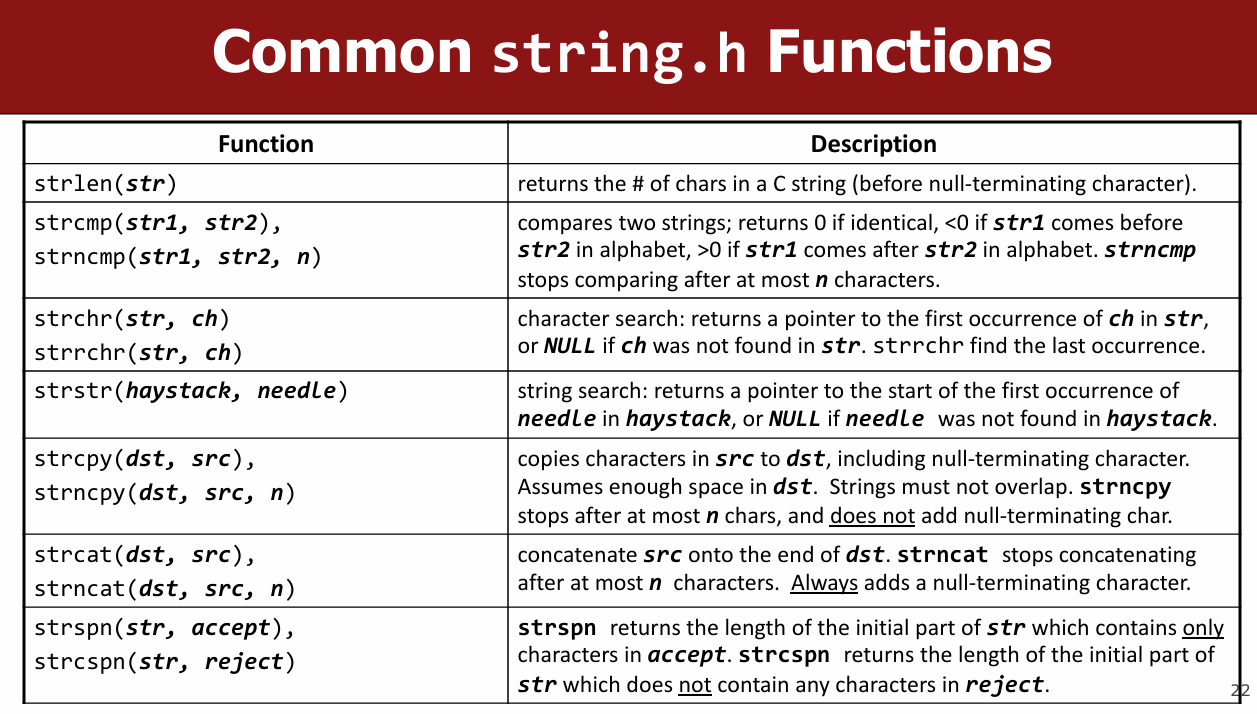
Common string.h Functions